Welcome to "Confessions"
The ramblings, hopefully useful ones, of a long-time computational scientist and educator. Discussions of everything and anything computational, in no particular order.

Welcome to “Confessions of a Computational Scientist”. I’m Bob Gotwals, a long-time computational scientist and computational science educator. I’ve worked in a variety of computational positions, including the North Carolina Supercomputing Center (RTP, NC), the Shodor Education Foundation (http://www.shodor.org), and, most recently, the North Carolina School of Science and Mathematics (NCSSM, Durham, NC), the #1-rated high school in the US (if you believe those rankings…I don’t, but hey, if someone says you’re #1, I’m happy to use that!)
I started my computational work in 1987. The year before that, ETA Systems (a supercomputing hardware company, now defunct) collaborated with the National Science Foundation (NSF) and the Cornell Theory Center (CTC) to get an answer to this question: “What would happen if you put a 16-year-old in front of a high-performance computer, i.e., a supercomputer?” To answer this, ETA and NSF knew they would have to start with some of the nation’s better students, and they knew that these kids were motivated by one thing and one thing only: winning academic competitions.
To that end, they established the “SuperQuest Supercomputing Challenge”. In this competition, students from several of the best science and math high school programs — Thomas Jefferson High School (TJ, Alexandria, VA), NCSSM, and my school, Montgomery Blair High School (MBHS, Silver Spring, MD) — spend the summer at CTC learning the technologies, techniques, and tools of high-performance computing (HPC). Then, they went home, and under the supervision of local teachers (who were learning alongside the kids), the students worked on individual and group projects that leveraged the capabilities of “big iron”. At the end of the year, projects were submitted to computational scientists at CTC, and a winning school was picked.
The winning school’s prize was a free ETA Systems supercomputer to be installed in the high school. TJ won that first year, and, sure enough, they received an ETA supercomputer. It didn’t last very long, however; the costs of maintaining the machine, especially the electric bill, were too much for a public high school to tolerate.
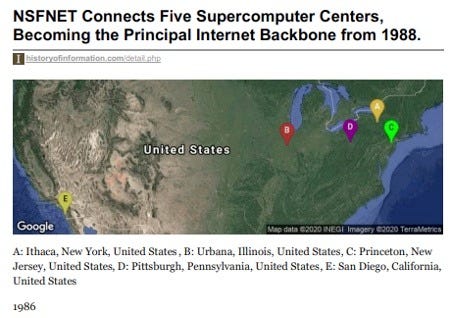
More importantly, however, all of the participating schools were connected to the NSFNET, an Internet backbone connecting the five NSF-funded supercomputing centers: National Center for Supercomputing Applications (NCSA, Illinois); the John von Neumann Supercomputing Center (Princeton, NJ); the Pittsburgh Supercomputing Center (Pittsburgh, PA); the San Diego Supercomputing Center (San Diego, CA); and the Cornell Theory Center (Ithaca, NY). In the late 80’s, it was pretty much unheard of for a high school to have on-demand Internet access. This access enabled our students to communicate with the machine at CTC via terminal-based access. No GUIs back then!
Four teachers were participating in this project: Don Hyatt at TJ, Lawrence Gound at NCSSM, and Mary Ellen Verona at MBHS. On my very first day at MBHS (where I was hired to build an analytical chemistry lab), Mary Ellen greeted me literally at the front school entrance, introducing herself, and then asked: “Do you want to coach SuperQuest?” Me, being young and not particularly too smart, said, “Sure…what’s SuperQuest?” None of the teachers knew anything about HPC. Don and Mary Ellen taught computer science, Lawrence taught math, and I taught chemistry. My very first “coaching” project was a kid looking at the Belousov-Zhabotinsky oscillating chemical reaction. Mathematically, this reaction is represented by a series of differential equations. What we didn’t realize was that these equations were “stiff”, meaning that the magnitudes of the various components were orders of magnitude different, requiring more sophisticated numerical solutions.
The competition lasted several years until ETA went bankrupt; nobody was buying their hardware. NSF funded a teacher version of SuperQuest, “SuperQuest for Teachers”, which lasted for several years, and was hosted by several supercomputing centers, including the North Carolina Supercomputing Center (NCSC). Dr. Larry Lee, the director of CTC, had been hired by NCSC to be their director, and he recruited me away from MBHS to join the scientific staff there, with a primary focus on education, outreach, and training (EOT).
NCSC was closed by the NC General Assembly some years later, and I moved to the Shodor Education Foundation, a national resource for computational science education. Working there with Dr. Robert Panoff, a computational theoretical physicist, where we created computational science education resources for undergraduate faculty and high school teachers. 100% funded by organizations such as NSF and the Burroughs Wellcome Fund, Shodor provided significant opportunities for young scientists, particularly through our “post-bac” program, to get experience in computational science and in working on NSF-funded grants. Shodor has recently closed its doors, but the website (http://www.shodor.org) is still available.
From Shodor, I was recruited to the chemistry department at NCSSM, with a mandate to establish a program in the computational sciences. Dr. Myra Halpin, then the Dean of Science and a hard-core experimental chemist, saw that the role of computing in the sciences was becoming increasingly important, and, if our school and our students were to continue to be on the cutting-edge, we needed those opportunities for our kids. At one point, we had 11 courses, including courses in biology/bioinformatics, chemistry, physics, nanotechnology, medicinal chemistry, scientific programming, digital humanities, and two research courses, one for residential students and one for online students.
Of the four original SuperQuest teachers, I’m the only one still teaching, and, to be honest, the only one still alive. I just transitioned to part-time this year, and will teach “Introduction to Computational Science”, “Computational Chemistry”, and “Medicinal Chemistry” for the next two years. After that, who knows? One reason for this Substack resource is to allow me to continue thinking about, talking about, and otherwise extending my career as a computational scientist and educator. My “retirement plan” was to help university faculty with their NSF proposals, particularly the EOT sections. That plan, however, has been stymied by the idiotic policies of the current administration in terms of NSF and NIH funding, and, personally, by a recent diagnosis of ocularbulbar myasthenia gravis. This autoimmune neuromuscular disease manifests itself with double vision, difficulty swallowing, and, most importantly, a limited ability to speak for long periods of time without muscular fatigue. My plan of conducting workshops and other activities for scientists and educators is not a likely option unless and until treatment gives me a little better ability to deal with the associated fatigue.
So, for this Substack, the plan is to have approximately monthly posts for the free subscribers. For paid subscribers, I’m looking to re-package the hundreds (thousands?) of computational labs that I’ve developed over almost 40 years and make them available to high school and university students and faculty. I’m primarily a Mathematica user, but many of my labs can be converted to leverage software tools in the public domain. I’m anticipating a new lab once a month.
I’m looking forward to my conversations with you. Computational science is a critically important research tool, and helping scientists, educators, and students to think computationally is a significant area of research in the educational community. Success requires an all-hands effort, and I’m anxious to play my part. I’ve learned a great deal over 40 years, and I'm hoping to pass some of those “lessons learned” back to the community.
Yours in computing,
Bob